‘A Metropolitan Fantasia of 20th-Century China: Art Deco, Tarot, and Myth’
Reimagining Chinese Art Deco Through Tarot
Eight silk hanging scrolls occupied the gallery of Fragments of Begonia Leaves in New York’s East Village, presenting an imagined visual world rooted in one of the most dynamic periods of Chinese modern design.
At the center of the exhibition is a series of tarot compositions. Artist and designer Chai Yehhxin uses the cards as a framework for exploring architecture, ornament, mythology, typography, and material culture.
The central subject of the exhibition is Chinese Art Deco in the first half of the twentieth century—not simply as a historical style, but as an unfinished possibility.
From Shanghai to Wuhan, Nanjing, Guangzhou, and Tianjin, Chinese cities in the early twentieth century became sites where traditional craftsmanship encountered modern architecture, international design, new materials, commercial culture, and rapidly changing urban life. Chinese Art Deco emerged from this encounter. Geometric modernism was not simply imported and reproduced; it was transformed through local materials, decorative traditions, architectural forms, and cultural symbols.
Fragments of Begonia Leaves imagines what this visual language might have become if its development had continued uninterrupted.
Designing the Card as Architecture
The tarot cards provide a particularly precise format for this investigation because each card functions simultaneously as an image, a symbol, and a designed object.
In Chai’s compositions, the frame is therefore as important as the central figure.
Inspired by Art Deco buildings, theatre façades, interiors, entrances, and decorative architectural details from the first half of the twentieth century, the borders are constructed through symmetry, stepped geometry, arches, radiating lines, and repeated geometric patterns.
These structures are combined with Chinese visual elements such as cloud motifs, meander patterns (回纹), traditional ornamental forms, and jade-like decorative lines.
The intention is not to place Chinese motifs inside an Art Deco frame as separate decorations. Instead, the two systems are reorganized into a single architectural language.
Material is equally important. The cards evoke the visual qualities of marble, obsidian, gilded metal, jade, glazed surfaces, lacquer, glass, and colored architectural panels. These materials create distinctions between layers of the composition, giving the cards the appearance of miniature architectural objects.
The result is a tarot deck in which the border does not merely contain the image. It establishes the cultural identity of the image.
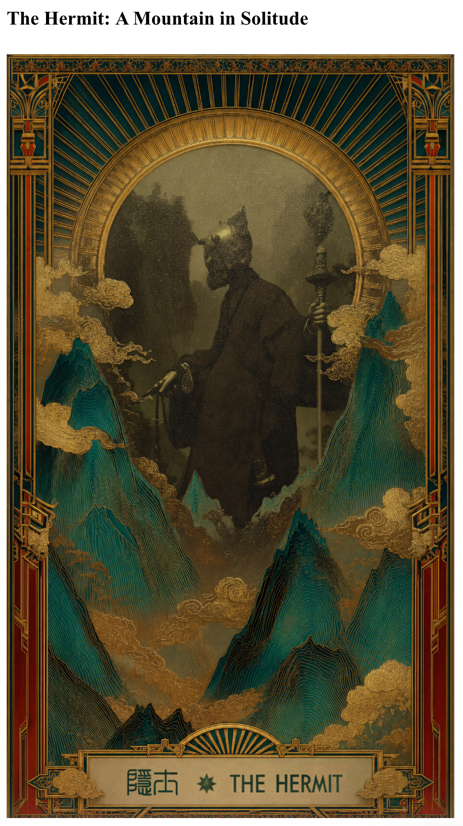
For The Hermit, the point of departure is Wang Ximeng’s A Thousand Li of Rivers and Mountains.
Instead of reproducing the famous landscape, Chai extracts its sense of monumental distance and transforms it into a new environment. A solitary Daoist figure stands among layers of towering mountains, clouds, and deep green-blue landscape forms.
The mountains are constructed through repeated linear contours, creating a visual rhythm that connects traditional landscape painting with the geometric discipline of Art Deco.
Around the scene, a large arched structure and radiating gold lines recall the monumental entrances and sunburst compositions of Art Deco architecture.
The card consequently places an ancient figure inside a modern architectural framework. Solitude, contemplation, and distance become not only narrative ideas, but properties of the entire composition.
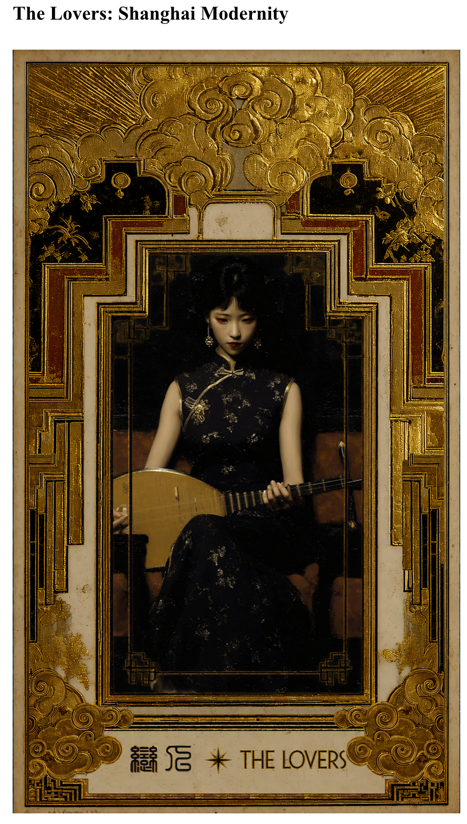
The Lovers moves from the mountains into the urban culture of Republican-era Shanghai.
Its central figure is a Shanghai dance-hall performer, dressed in a qipao and holding a traditional string instrument. The image evokes the sophisticated nightlife and entertainment culture associated with Shanghai’s modern urban society.
Around her, the border becomes an elaborate architectural structure of gold, dark surfaces, geometric lines, and cloud ornament.
The contrast between the intimate portrait and the monumental frame is deliberate. The woman represents a particular moment of urban modernity, while the surrounding architecture places that moment within the larger visual culture of the period.
Here, Art Deco is not merely an imported European aesthetic. It becomes part of a distinctly Chinese urban imagination—one shaped by fashion, performance, architecture, music, commerce, and cosmopolitan life.
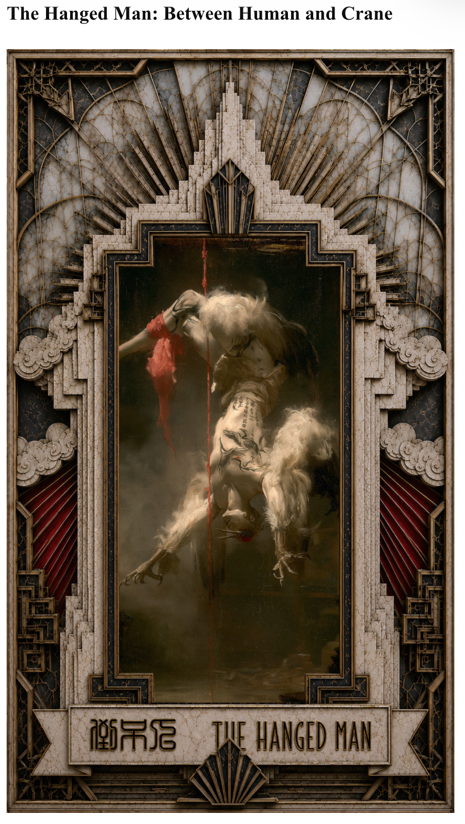
The Hanged Man introduces a more fantastical interpretation.
The central figure is a human performer disguised as a crane—a fictionalist suspended between human identity and an imagined animal form.
The figure hangs vertically within a monumental architectural frame, creating a visual tension between suspension and structure, transformation and order.
The border is built from stepped geometric forms, pale marble-like surfaces, dark panels, red glazed elements, and glass-like decorative structures. Its upward movement recalls the verticality of Art Deco façades and theatre interiors, while the layered geometry gives the card the appearance of a constructed architectural portal.
The crane itself introduces another layer of Chinese cultural symbolism. Traditionally associated with longevity, transcendence, and the realm between the earthly and celestial, it becomes here a figure of transformation.
The card therefore turns the tarot archetype into a meditation on identity, illusion, and the desire to cross the boundary between the human and the imagined.
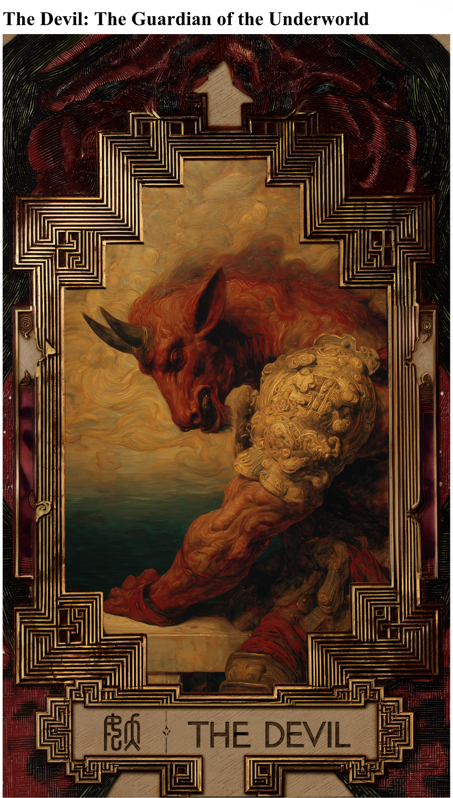
The final card, The Devil, draws upon the traditional Ma Mian, the horse-faced guardian associated with the underworld.
Chai turns to a distinctly Chinese figure associated with judgment, punishment, and the passage between worlds.
The central figure is rendered in an intense palette of crimson, black, and gold. Elaborate armor and ornamental surfaces give the character a monumental presence, while the surrounding geometric frame creates an almost temple-like architectural structure.
The border incorporates repeated geometric patterns, cloud ornament, dark jade-like surfaces, and gilded lines. The combination of black, red, and gold produces a sense of authority and danger, while the rigid symmetry of the frame suggests the institutional order of the underworld itself.
The result is not simply a reinterpretation of a tarot character. It is a collision between two systems of mythology, reconstructed through a shared visual language.
A New Visual Grammar
Across the four cards, the characters and narratives change dramatically: a Daoist hermit, a Shanghai performer, a crane-like fantasy figure, and an underworld guardian.
What holds them together is the design system.
Architecture becomes the border. Materials become visual symbols. Cloud patterns and meander motifs become structural elements. Gold becomes both ornament and line. Typography becomes part of the architectural hierarchy.
This is the central idea of Fragments of Begonia Leaves: tradition does not have to remain a historical surface. It can become a design grammar capable of generating new images.
By placing Chinese mythology, landscape painting, Republican-era urban culture, and traditional decorative motifs within the formal discipline of twentieth-century Art Deco, Chai Yehhxin proposes an alternative continuity between Chinese tradition and modern design.
The tarot cards are therefore fragments of a larger imagined civilization.
They do not reconstruct the past exactly as it was.
Instead, they ask what Chinese modernism might have looked like if its visual language had been allowed to continue evolving—through new materials, new architectures, new symbols, and new forms of storytelling.
Continuing the Journey
Fragments of Begonia Leaves is not a finished visual system.
The tarot series continues to expand, with new cards, characters, symbols, and visual structures currently under development. As the project grows, its mythology and design language will continue to develop beyond the exhibition space, gradually extending into a complete tarot IP.
The first edition of the tarot collection is expected to be released soon, bringing the visual language developed through Fragments of Begonia Leaves into a physical, collectible form.
For Chai Yehhxin, the exhibition is therefore only one chapter in an ongoing project—one that continues to explore how Chinese history, Art Deco, mythology, and contemporary visual design can come together to create a new cultural language.
Articolo pubblicato da Museo MIIT – Direzione Dr. Guido Folco
Artist
Chai Yehhxin
New York, USA
Art Director & 3D Digital Artist & Concept Designer & Illustrator
Website: chviovs.net
Instagram: @yehhxin1911